
DSW vs PSW in Ontario | What’s the Difference?

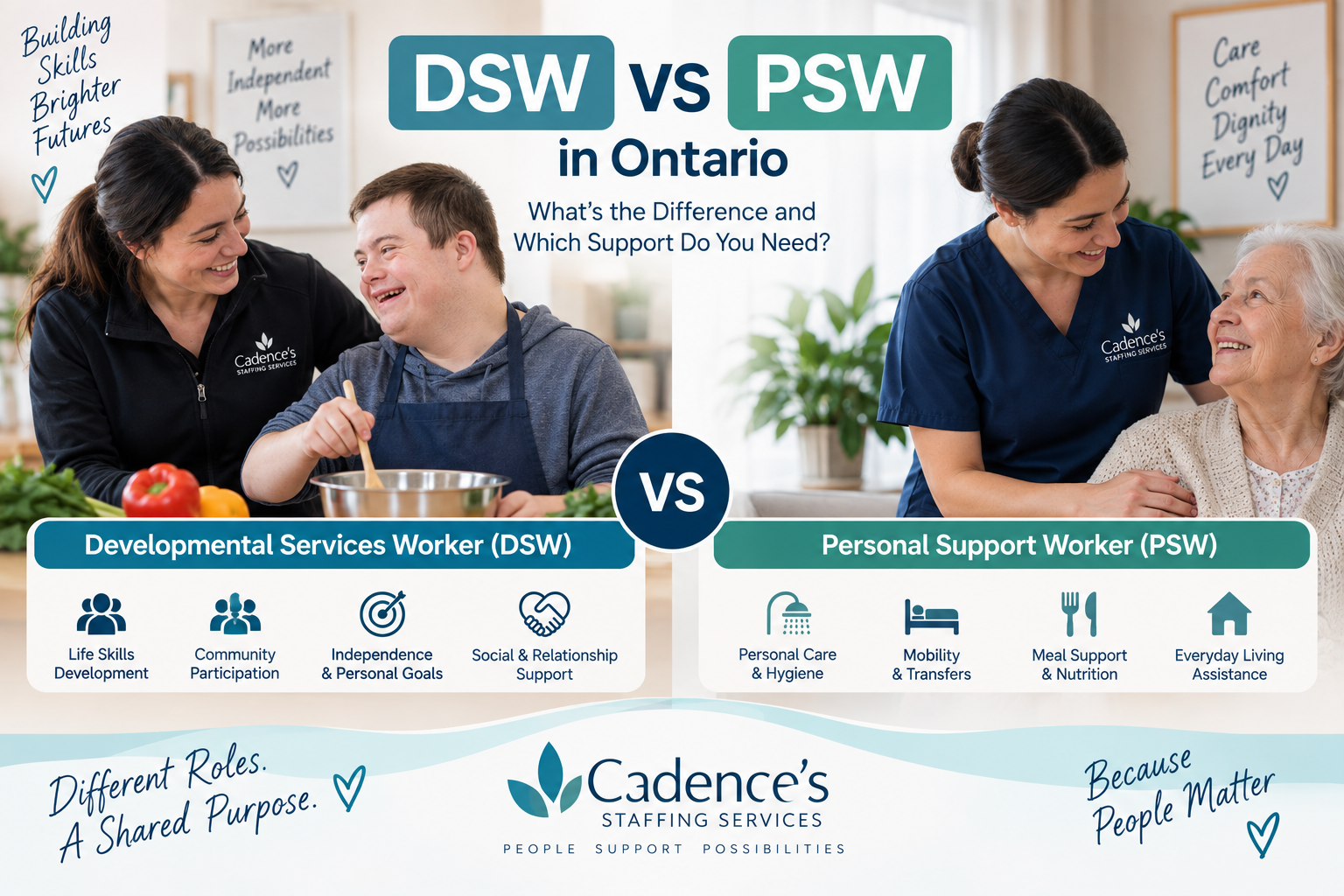
DSWVS PSW

DSW vs PSW — what’s the difference, and how do you know which type of support is right for you or your loved one?

Developmental Services Workers (DSWs) and Personal Support Workers (PSWs) both provide valuable support to people who may need assistance in their everyday lives. However, their training, areas of focus and the type of support they typically provide are different.

For families, caregivers and organizations in Ontario, understanding the difference between a DSW and PSW can make it easier to find support that aligns with an individual’s needs, abilities and goals.

In this guide, we’ll compare DSW vs PSW roles, explore where their responsibilities can overlap and explain some of the factors to consider when choosing support.

DSW vs PSW: What’s the Main Difference?

The simplest way to understand the DSW vs PSW distinction is to look at the primary focus of each role.

A Developmental Services Worker (DSW) is trained specifically to support people with developmental disabilities. Their work can focus on developing adaptive and life skills, promoting independence, supporting relationships, facilitating community participation and helping individuals work toward person-directed goals.

A Personal Support Worker (PSW) typically provides hands-on assistance with activities of daily living and personal care. Depending on the person and setting, this can include support with mobility, hygiene, dressing, eating and other everyday needs.

Both roles are important.

The better choice isn’t about which professional is “more qualified.” It is about which type of training and support best matches the individual’s needs.

What Does a DSW Do?

A Developmental Services Worker supports people with developmental disabilities in increasing their capacity to participate in everyday life and their communities.

A DSW’s work can look different depending on the person they support.

Some individuals may need significant daily assistance, while others may primarily need support developing skills, navigating their community, building relationships or working toward greater independence.

A DSW May Support:

  • Daily living and adaptive skills
  • Community participation
  • Social and communication skills
  • Building and maintaining relationships
  • Healthy routines
  • Person-directed goals
  • Independence and self-determination
  • Behavioural strategies
  • Safety and crisis intervention, where appropriate
  • Medication support where appropriate to the role and setting
  • Family and community relationships

The emphasis is often on working with the individual rather than simply doing everything for them.

For example, instead of automatically preparing someone’s meal, a DSW might support the individual in choosing a meal, shopping for ingredients and participating in the preparation based on their abilities.

That distinction can be an important part of developmental support.

What Does a PSW Do?

A Personal Support Worker provides assistance to individuals who need help with everyday activities, personal care and maintaining their quality of life.

PSWs work with many different populations and in a variety of care environments.

Depending on the person’s needs and the setting, a PSW may provide assistance with:

  • Bathing and personal hygiene
  • Dressing and grooming
  • Eating and drinking
  • Mobility
  • Positioning and transfers
  • Toileting
  • Everyday household activities
  • Companionship
  • Supporting established care routines
  • Observing and reporting changes in a person’s condition

PSWs may work in private homes, community settings, retirement homes, long-term care environments and other care settings.

Their role can be particularly valuable for individuals who require regular hands-on assistance with activities of daily living.

DSW vs PSW: Side-by-Side Comparison

While individual responsibilities depend on the workplace, support plan and needs of the person receiving services, this general comparison can help clarify the difference.

Area of SupportDSWPSW
Developmental disability supportPrimary area of specializationMay support individuals with disabilities
Personal careMay provide depending on role and settingMajor area of support
Daily living skillsStrong focus on developing skills and independenceOften assists with completing daily activities
Community participationStrong focusMay provide depending on care plan
Person-directed goalsCore componentMay contribute within care plan
Social and relationship skillsCommon area of supportMay provide companionship and social support
Mobility and transfersMay assist depending on role/trainingCommon responsibility
Personal hygieneMay assist depending on needs and settingCommon responsibility
Behavioural supportMay be part of developmental supportDepends on training and setting
Independence buildingCentral focusSupports independence within personal care needs
Developmental services settingsCommonPossible
Home and community carePossibleCommon

These are general distinctions rather than rigid boundaries. The exact responsibilities of either professional can vary according to their training, employer policies, individual competence and the person’s support plan.

DSW vs PSW for Developmental Disabilities

This is where the distinction becomes particularly important.

If an individual has a developmental disability, their needs may extend beyond personal care.

They may benefit from support with communication, social skills, community participation, decision-making, adaptive skills, routines, relationships and long-term independence.

A DSW’s education is specifically oriented toward supporting people with developmental disabilities.

That can make DSW support particularly appropriate when the primary objective is to help an individual develop skills, participate in their community and pursue person-directed goals.

However, having a developmental disability does not automatically mean someone needs a DSW instead of a PSW.

An individual with a developmental disability may also have significant personal care or mobility needs.

In some circumstances, their support needs may involve elements commonly associated with both DSW and PSW services.

The decision should therefore begin with the person—not simply their diagnosis.

When Might You Choose a DSW?

A Developmental Services Worker may be appropriate when an individual’s primary needs involve developmental support, skill building, community participation and independence.

For example, DSW support may be worth considering when someone needs assistance with:

Building Life Skills

A DSW can help an individual develop practical skills such as preparing meals, grocery shopping, managing routines, navigating transportation or participating in household responsibilities.

Increasing Independence

The goal may be to gradually help the person accomplish more independently rather than having someone continuously perform tasks for them.

Participating in the Community

A DSW may support an individual in attending activities, appointments, recreational programs, volunteer opportunities or other community experiences.

Developing Social and Communication Skills

Support may include helping the individual communicate preferences, navigate social situations, develop relationships or strengthen interpersonal skills.

Working Toward Personal Goals

A DSW can help support person-directed goals based on what matters to the individual, their abilities and their desired quality of life.

When Might You Choose a PSW?

A Personal Support Worker may be appropriate when the individual’s primary needs involve hands-on personal assistance and activities of daily living.

For example, PSW support may be worth considering when someone needs regular assistance with:

Personal Hygiene

This can include bathing, grooming, oral care and other personal routines.

Dressing

A PSW may assist someone who has difficulty dressing independently.

Mobility and Transfers

Individuals with physical limitations may require assistance moving safely, repositioning or transferring between surfaces.

Eating and Drinking

Some individuals may need assistance during meals or with other aspects of their daily nutrition routine.

Everyday Personal Support

A PSW may provide assistance that allows an individual to remain comfortable and participate in everyday routines while maintaining as much independence as possible.

Can Someone Need Both a DSW and a PSW?

Yes.

Support needs don’t always fit neatly into one professional category.

Someone may have a developmental disability and also require significant assistance with mobility or personal care.

For example, an adult with a developmental disability may benefit from a DSW for community participation, skill development and person-directed goals while also requiring substantial hands-on personal care.

Depending on the service arrangement and the professionals involved, these needs may be supported by different workers or incorporated into a broader individualized support plan.

What matters is ensuring the person receives the appropriate support from workers who have the training, competence and role expectations necessary to provide it safely.

DSW vs PSW: Which Is Better for Independence?

Both DSWs and PSWs can support independence, but they may approach it from different perspectives.

For a DSW, developing independence is often a central part of developmental services work.

This might involve breaking a task into manageable steps, allowing the individual to practise, adapting the environment or gradually reducing assistance as their skills develop.

A PSW also supports independence by encouraging individuals to participate in their own care and complete activities they are capable of performing.

Neither approach should unnecessarily take control away from the person receiving support.

Good support recognizes abilities, respects choices and provides assistance where it is actually needed.

How to Decide Between a DSW and PSW

Instead of beginning with the question, “Do we need a DSW or PSW?”, begin with a different question:

“What does this person need support with?”

Consider:

  • What can the individual currently do independently?
  • Which activities are challenging?
  • Are their primary needs related to personal care?
  • Do they need support developing new skills?
  • Would they benefit from more community participation?
  • Are communication or social skills an area of focus?
  • Are mobility or transfers a significant concern?
  • What personal goals would they like to work toward?
  • How much hands-on assistance do they require?
  • Are there behavioural or complex support needs to consider?
  • What type of support would help improve their quality of life?

Once the actual needs are clear, it becomes much easier to determine which type of professional may be appropriate.

Choosing the Right Support Worker Matters Too

Credentials and job titles matter, but they are only part of finding the right support.

The relationship between an individual and their support worker can have a significant impact on the experience.

Families and organizations should also consider qualities such as:

  • Reliability
  • Patience
  • Communication
  • Professionalism
  • Respect
  • Adaptability
  • Relevant experience
  • Ability to follow individualized support plans
  • Comfort working with the individual’s specific needs
  • Commitment to dignity and person-centred support

A worker may have the appropriate credentials but still not be the right personality or support match for every individual.

The goal should be finding someone who has both the appropriate skills and the ability to build a respectful, dependable working relationship.

Finding DSW and PSW Support in Ontario

Finding the appropriate support starts with understanding the person.

At Cadence’s Staffing Services, we provide both Developmental Services Workers and Personal Support Workers to support individuals, families and organizations.

Our goal is to understand the needs of the individual or organization before determining the type of support required.

For families, that may mean finding a professional who can support a loved one’s daily routines, independence, community participation or personal care.

For organizations, it may mean accessing qualified DSW or PSW staffing to help maintain reliable support and continuity of care.

Rather than simply filling a position, the focus should always be on finding the appropriate professional for the environment and the people being supported.

Need Help Choosing Between a DSW and PSW?

If you’re still unsure about DSW vs PSW support, you don’t have to make the decision based on a job title alone.

Start by identifying the individual’s daily needs, abilities, challenges and goals.

Cadence’s Staffing Services can help families and organizations explore their support needs and determine which type of staffing may be appropriate.

Contact Cadence’s Staffing Services to discuss DSW and PSW support in Ontario and learn more about the services available.

Frequently Asked Questions About DSW vs PSW

What is the main difference between a DSW and PSW?

A Developmental Services Worker is specifically trained to support people with developmental disabilities, with an emphasis on areas such as adaptive skills, community participation, relationships and person-directed goals. A Personal Support Worker generally focuses more heavily on personal care and activities of daily living.

Is a DSW the same as a PSW?

No. DSWs and PSWs are different roles with different educational focuses, although some of their responsibilities can overlap depending on the individual and work environment.

Can a DSW provide personal care?

Depending on the person’s needs, the setting, employer policies and the worker’s training and responsibilities, a DSW may assist with aspects of personal care. The exact responsibilities should be determined by the individual’s support plan and service provider.

Can a PSW work with someone who has a developmental disability?

Yes. PSWs can support people with disabilities, particularly when assistance with personal care, mobility or other activities of daily living is required.

Is a DSW better than a PSW for someone with autism or another developmental disability?

Not necessarily. The appropriate type of support depends on the individual’s specific needs rather than diagnosis alone. Someone primarily needing developmental skill-building and community support may benefit from a DSW, while someone requiring substantial personal care may benefit from PSW support. Some individuals may require a combination of supports.

Can someone have both DSW and PSW support?

Yes. An individual’s needs can include developmental support as well as personal care. Depending on the service arrangement, different professionals may contribute to an individualized support plan.

How do I know whether my loved one needs a DSW or PSW?

Consider what the individual actually needs help with. Developmental skill-building, community participation and person-directed goals may point toward DSW support, while substantial assistance with hygiene, mobility, dressing and other activities of daily living may point toward PSW support. A support provider can help assess which service is the better fit.
DSW vs PSW in Ontario | What’s the Difference?

DSW vs PSW — what’s the difference, and how do you know which type of support is right for you or your loved one? Developmental Services Workers (DSWs) and Personal Support Workers (PSWs) both provide valuable support to people who may need assistance in their everyday lives. However, their training, areas of focus and the type…

What Does a Developmental Services Worker (DSW) Do in Ontario?

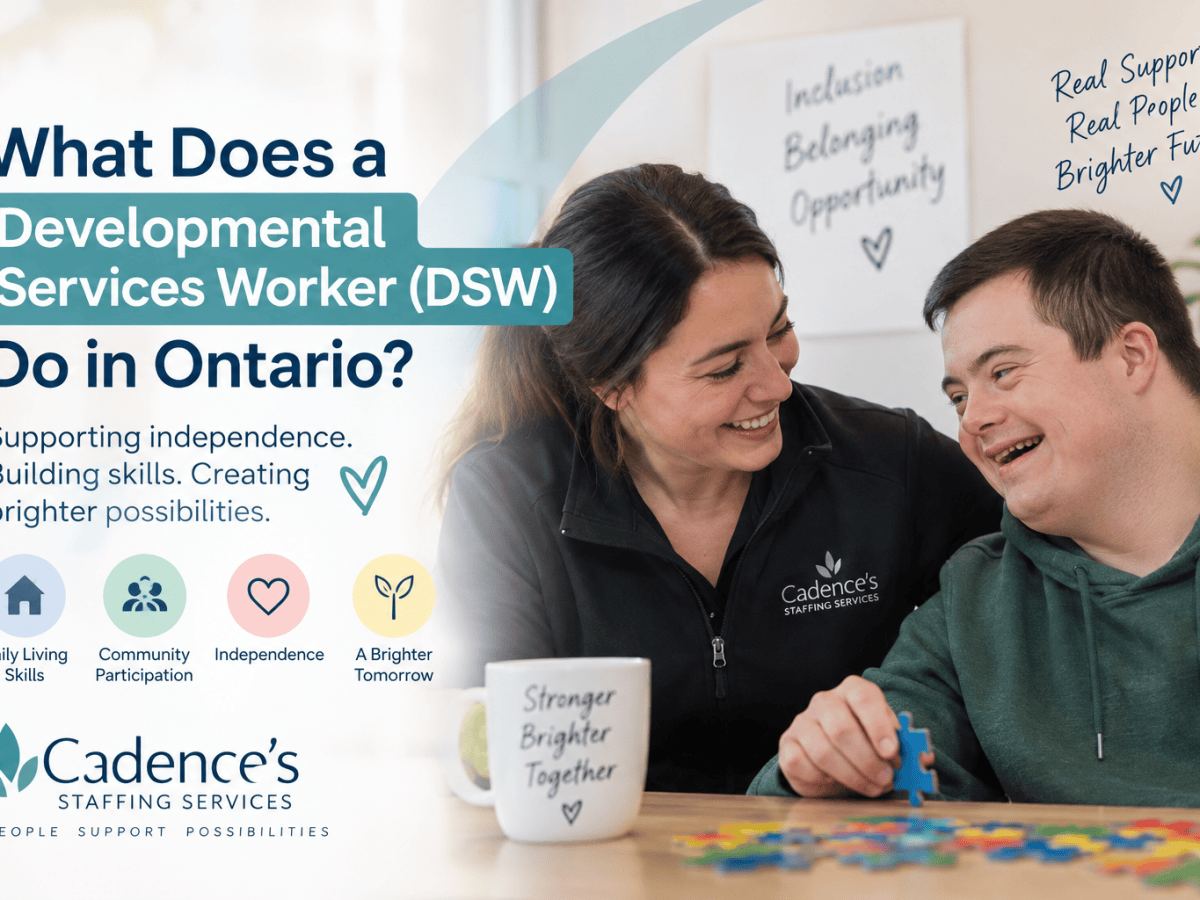
A Developmental Services Worker supports people with developmental disabilities in building independence, developing everyday skills, participating in their communities and working toward personal goals. For families and organizations across Ontario, Developmental Services Workers — commonly known as DSWs — can provide valuable support at home, in residential environments and throughout the community. But what exactly does a…

Healthcare Staffing in Ontario | What’s Changing

The Future of Healthcare Staffing in Ontario | What’s Changing and How Cadence’s Is Responding The Future of Healthcare Staffing in Ontario | What’s Changing and How Cadence’s Is Responding Healthcare staffing in Ontario is changing. Across hospitals, long-term care settings, developmental services, residential programs and community-based care, organizations are navigating a workforce environment that requires…

What Does a Developmental Services Worker (DSW) Do in Ontario?

A Developmental Services Worker supports people with developmental disabilities in building independence, developing everyday skills, participating in their communities and working toward personal goals.

For families and organizations across Ontario, Developmental Services Workers — commonly known as DSWs — can provide valuable support at home, in residential environments and throughout the community.

But what exactly does a Developmental Services Worker do, and when might DSW support be appropriate?

In this guide, we explain the role of a Developmental Services Worker in Ontario, their day-to-day responsibilities and how they can support individuals, families and organizations.

What Is a Developmental Services Worker?

A Developmental Services Worker is a trained professional who supports people with developmental disabilities in different areas of everyday life.

Unlike a role focused solely on completing tasks for an individual, developmental services work emphasizes supporting the person to develop skills, exercise choice, participate in their community and work toward greater independence.

Depending on an individual’s needs, Developmental Services Workers may provide support in residential settings, family homes, community programs, workplaces, educational environments or other community-based settings.

At its core, the work is person-centred.

Every individual has different abilities, preferences, goals and support needs. Effective developmental support begins by recognizing the person first rather than defining them by their disability.

What Does a Developmental Services Worker Do Day to Day?

There is no single “typical” day for a Developmental Services Worker.

One individual may need support learning how to prepare meals or manage money. Another may need assistance participating in community activities. Someone else may require more comprehensive support with daily routines, communication, behaviour, personal care or safety.

A Developmental Services Worker’s responsibilities can therefore vary considerably depending on the individual and the environment.

1. Developmental Services Worker Support for Daily Living Skills

Developmental Services Workers can help individuals develop and maintain skills that contribute to greater independence.

This may include support with:

  • Meal preparation and cooking
  • Grocery shopping
  • Cleaning and household routines
  • Budgeting and money management
  • Personal organization
  • Transportation and navigating the community
  • Healthy lifestyle choices
  • Personal care, where required

The objective is not simply to complete every task on someone’s behalf.

Where appropriate, a Developmental Services Worker works alongside the individual to help them participate, learn and build confidence in doing as much as they can for themselves.

2. Encouraging Independence

Independence looks different for every person.

For one individual, independence might mean learning to take public transportation. For another, it may mean preparing breakfast, choosing their clothing, making a purchase at a store, participating in an activity without a family member present or communicating their preferences more confidently.

A good Developmental Services Worker recognizes those individual goals and helps create realistic opportunities to work toward them.

Progress can happen through seemingly small everyday moments, and those moments can have a significant impact on someone’s quality of life.

3. Developmental Services Worker Support in the Community

Being part of a community is an important component of a fulfilling life.

A Developmental Services Worker can support individuals in participating in activities that reflect their interests and goals.

That might include:

  • Attending recreational programs
  • Going swimming or bowling
  • Visiting a gym
  • Grocery shopping
  • Attending appointments
  • Participating in social activities
  • Exploring hobbies
  • Volunteering
  • Participating in community events

At Cadence’s Staffing Services, our DSWs may support individuals with activities such as sporting events, swimming, grocery shopping, medical appointments, gym visits and other community experiences.

The goal is greater than simply getting out of the house. Meaningful community participation can help individuals build relationships, practise skills, develop confidence and experience a stronger sense of belonging.

4. Supporting Communication and Relationships

Communication is another important area of developmental support.

Some individuals communicate verbally, while others may use alternative or augmentative methods of communication.

A Developmental Services Worker takes the time to understand how the person communicates and supports them in expressing their needs, preferences and choices.

Developmental Services Workers may also help individuals develop and maintain healthy relationships with family members, peers, caregivers and other people in their communities.

5. Supporting Person-Directed Goals

Quality developmental support should not be built around what everyone else thinks a person should accomplish.

The individual’s own preferences, abilities and goals matter.

A Developmental Services Worker may work alongside an individual, their family and other members of their support network to identify goals and develop strategies for achieving them.

Those goals could involve becoming more independent at home, participating in the community, improving communication skills, building relationships, developing employment-related skills or learning new daily living skills.

6. Providing Behavioural and Crisis Support

Some people with developmental disabilities may have complex behavioural or emotional support needs.

Depending on their training, role and the individual’s support plan, Developmental Services Workers may help recognize triggers, implement established behavioural strategies, support emotional regulation and respond appropriately during challenging situations.

Consistency can be especially important.

When a Developmental Services Worker understands an individual’s communication style, routines, preferences and support strategies, they are better positioned to respond in ways that protect dignity while maintaining safety.

7. Supporting Families and Caregivers

Developmental support does not only affect the individual receiving services. It can also make a meaningful difference for families.

Parents and caregivers often carry substantial responsibility for appointments, transportation, routines, personal care, advocacy, supervision and countless other aspects of everyday life.

Having a qualified Developmental Services Worker can provide additional support while giving the individual opportunities to develop relationships and experiences outside their immediate family.

For some families, DSW support may also form part of a broader respite strategy, providing caregivers with time to work, attend appointments, spend time with other family members, rest or recharge.

Developmental Services Worker vs. PSW: What’s the Difference?

Developmental Services Workers and Personal Support Workers can both provide valuable support, but their education, areas of focus and responsibilities are different.

A PSW’s work often focuses heavily on personal care and activities of daily living, particularly for people who require assistance because of age, illness, injury or disability.

A Developmental Services Worker is specifically trained to support people with developmental disabilities, with an emphasis on areas such as adaptive skills, social inclusion, person-directed planning, community participation and independence.

There can be overlap between the two roles depending on the person’s needs and service environment.

Understanding those differences is important when deciding what type of support is most appropriate.

Read our guide: DSW vs. PSW in Ontario: What’s the Difference and Which Support Do You Need?

Who Can Benefit From a Developmental Services Worker?

There isn’t a single profile of someone who may benefit from developmental support.

Developmental Services Workers may support people with developmental disabilities who need assistance with areas such as:

  • Daily living
  • Community participation
  • Communication
  • Social skills
  • Behavioural support
  • Personal goals
  • Increasing independence

Families may also seek developmental support when their loved one’s needs change or when additional support is needed alongside existing family or community resources.

Organizations serving people with developmental disabilities may use qualified Developmental Services Workers to complement their existing workforce, maintain staffing coverage and provide consistent support within their programs.

What Makes a Good Developmental Services Worker?

Training and experience matter, but exceptional developmental support also requires strong interpersonal qualities.

A good Developmental Services Worker should demonstrate patience, professionalism, reliability, empathy, adaptability and strong communication skills.

They should also understand something fundamental:

Supporting independence sometimes means knowing when to help — and when to step back.

The objective isn’t to take control of someone’s life. It is to provide the appropriate level of support so the individual can participate in decisions, develop their abilities and pursue a life that reflects who they are.

Trust is equally important.

Families and organizations are placing significant responsibility in the hands of professionals supporting the people they care for. Dependability, communication, accountability and respect should therefore be central to the relationship.

Finding a Developmental Services Worker in Ontario

Finding the right Developmental Services Worker is about more than filling a shift.

The individual’s personality, communication style, needs and goals should be considered when determining whether a support worker is a good fit.

At Cadence’s Staffing Services, we provide Developmental Services Workers who collaborate with individuals, families and organizations to deliver personalized support in community and residential settings.

Our approach centres on understanding the individual’s needs and supporting goals that encourage participation, growth and greater independence.

Cadence’s also provides staffing solutions to organizations requiring qualified developmental support professionals.

Looking for a Developmental Services Worker in Ontario?

Whether you are a family looking for additional support for a loved one or an organization seeking qualified Developmental Services Workers, finding the right person matters.

Cadence’s Staffing Services works with families and organizations to provide dependable, compassionate developmental support tailored to individual needs.

Contact Cadence’s Staffing Services to discuss your support or staffing needs and learn how our team can help.

Frequently Asked Questions About Developmental Services Workers

What does a Developmental Services Worker do?

A Developmental Services Worker supports people with developmental disabilities in areas such as daily living skills, community participation, relationships, communication, personal goals and independence.

What does DSW stand for in Ontario?

DSW commonly stands for Developmental Services Worker in Ontario.

Where does a Developmental Services Worker work?

Developmental Services Workers can work in residential programs, community agencies, family homes and other environments where developmental support is provided.

Can a Developmental Services Worker help with life skills?

Yes. Depending on the individual’s needs, a Developmental Services Worker may support skills such as cooking, cleaning, budgeting, shopping, transportation and community participation.

Can a Developmental Services Worker provide respite support?

Depending on the service arrangement and the individual’s needs, a Developmental Services Worker may provide support that also gives a family caregiver a temporary break from their usual caregiving responsibilities.

Healthcare Staffing in Ontario | What’s Changing

The Future of Healthcare Staffing in Ontario | What’s Changing and How Cadence’s Is Responding

The Future of Healthcare Staffing in Ontario | What’s Changing and How Cadence’s Is Responding

Healthcare staffing in Ontario is changing.

Across hospitals, long-term care settings, developmental services, residential programs and community-based care, organizations are navigating a workforce environment that requires greater flexibility than ever before.

Unexpected absences can leave shifts uncovered. Vacant positions can take time to fill. Existing employees may be asked to take on additional responsibilities, while managers spend valuable time trying to maintain adequate coverage.

At the same time, the people receiving care and support still depend on organizations to provide consistent, compassionate and reliable services.

This changing environment is reshaping how organizations think about staffing.

Temporary staffing is no longer simply a last-minute solution for an empty shift. For many organizations, it can become part of a broader workforce strategy designed to provide additional capacity when permanent teams are stretched.

At Cadence’s Staffing Services, we believe the future of staffing is about more than availability. It’s about finding the right people, supporting existing teams and helping organizations maintain continuity of care.

Why Healthcare Staffing in Ontario Is Changing

Healthcare and developmental services organizations have always experienced staffing challenges.

What is changing is the level of flexibility organizations increasingly need to manage them.

Permanent recruitment remains essential, but permanent hiring alone cannot address every workforce situation.

An employee may suddenly become ill.

Someone may begin maternity or parental leave.

A permanent position may remain vacant while recruitment is underway.

Several employees may request vacation during the same period.

A new program may require additional staff.

Service demand may increase unexpectedly.

In each situation, the organization still needs to maintain its services.

This is why healthcare staffing in Ontario is increasingly becoming part of proactive workforce planning rather than simply emergency coverage.

1. Organizations Need More Flexible Staffing Options

Healthcare doesn’t operate around a traditional nine-to-five schedule.

Many services operate evenings, nights, weekends and holidays. Residential and community-based programs may require support around the clock.

That means staffing needs can change quickly.

A schedule that appears fully covered today can look very different tomorrow morning after an unexpected absence.

Flexible staffing gives organizations another option when their internal workforce cannot provide the necessary coverage.

Temporary staff may help with:

  • Sick-leave coverage
  • Vacation coverage
  • Temporary vacancies
  • Difficult-to-fill shifts
  • Recruitment periods
  • Increased service demand
  • Short-term programs
  • Additional workforce capacity

The objective isn’t to replace permanent employees.

It’s to provide organizations with another layer of workforce support when they need it.

2. Employee Well-Being Is Part of the Staffing Conversation

When a staffing shortage occurs, existing employees often become the first solution.

Someone stays late.

Another employee accepts an additional shift.

A supervisor rearranges the schedule.

A reliable team member agrees to work overtime again.

Occasionally, these solutions may work.

When they become routine, however, organizations may find themselves depending heavily on the same employees to compensate for ongoing staffing gaps.

A strong workforce strategy should therefore consider more than simply whether a shift is technically covered.

Organizations should also consider the sustainability of that coverage.

Having access to additional staffing resources can help reduce dependence on repeated overtime and give organizations more options when permanent employees are unavailable.

Supporting the workforce ultimately helps support the people relying on that workforce.

3. Speed Is Important, but Fit Matters Too

When an organization urgently needs someone for a shift, the natural question is:

Who is available?

But another question is equally important:

Who is appropriate for this environment?

Healthcare and developmental services roles are not interchangeable.

Different settings may require different education, skills and experience.

For example, a Developmental Services Worker may be appropriate when supporting individuals with developmental disabilities and person-directed goals.

A Personal Support Worker may be needed when assistance with personal care and activities of daily living is a central part of the role.

Some environments may require an RN or RPN for clinical responsibilities.

Organizations may also need workers with experience related to communication differences, behavioural support, mobility needs or specific support environments.

The future of healthcare staffing in Ontario isn’t simply about filling shifts faster.

It’s about making better staffing matches.

4. Developmental Services Staffing Requires Specialized Understanding

Developmental services are an important part of Ontario’s broader support system.

Professionals working within these environments may support individuals with:

  • Daily living skills
  • Communication
  • Community participation
  • Personal goals
  • Relationships
  • Behavioural strategies
  • Personal care
  • Decision-making
  • Healthy routines
  • Greater independence

A Developmental Services Worker (DSW), for example, receives education specifically focused on supporting people with developmental disabilities.

For group homes, residential programs and developmental services organizations, understanding the difference between a DSW, PSW, nurse and other support professionals can help ensure the right type of worker is requested for each role.

Staffing shouldn’t begin with a job title alone.

It should begin with understanding what the person, shift and environment actually require.

5. Continuity of Care Is Becoming Even More Important

Every open shift represents more than a scheduling problem.

There is a person behind it.

For individuals receiving ongoing support, familiarity and consistency can be important.

A regular support worker may understand how someone communicates.

They may know their morning routine.

They may recognize when the individual is uncomfortable.

They may understand which activities they enjoy, what their personal goals are and which strategies help them participate successfully in daily life.

Temporary staffing naturally means that different professionals may occasionally enter an established environment.

The goal should therefore be to reduce unnecessary disruption.

Organizations can help protect continuity through:

  • Clear support plans
  • Effective shift documentation
  • Appropriate orientation
  • Strong communication
  • Detailed staffing requests
  • Thoughtful worker matching
  • Consistent procedures

Where possible, organizations and staffing partners may also benefit from building relationships with workers who become familiar with particular environments.

6. Technology Is Making Staffing More Efficient

Technology is changing nearly every part of workforce management.

Digital recruitment, electronic documentation, online onboarding, scheduling platforms and faster communication tools can help organizations and staffing providers coordinate workers more efficiently.

These tools can improve speed.

But technology shouldn’t replace human judgment.

A system may tell you that a worker is available.

It cannot fully understand every individual’s personality, communication style, support needs or the dynamics of a particular environment.

The strongest staffing approach combines efficient technology with human communication and thoughtful decision-making.

The Future of Healthcare Staffing in Ontario Is Proactive

One of the biggest changes happening in staffing is a shift from reactive workforce management toward proactive planning.

Instead of waiting until a staffing shortage becomes an emergency, organizations can identify vulnerabilities ahead of time.

Ask:

  • Which shifts are consistently difficult to fill?
  • Which roles take the longest to recruit?
  • How often are employees working overtime?
  • What happens when someone calls in sick?
  • Are certain periods consistently understaffed?
  • How much time do managers spend finding coverage?
  • Do we have a reliable backup staffing option?

These questions can reveal patterns.

And patterns make planning possible.

Temporary Staffing Can Be Part of a Long-Term Workforce Strategy

Temporary staffing is sometimes associated exclusively with emergencies.

But organizations can use it more strategically.

Imagine an organization knows several employees will be taking vacation during the summer.

Instead of waiting until the week before those vacations to begin looking for coverage, staffing needs can be anticipated.

The same principle applies to parental leave, extended absences, recruitment periods, seasonal demand and planned organizational growth.

Temporary staffing can help bridge gaps while an organization continues building its permanent workforce.

Permanent employees remain the foundation.

Temporary professionals provide additional flexibility around that foundation.

What Should Organizations Look for in a Healthcare Staffing Partner?

As the demand for flexible staffing grows, choosing the right staffing partner becomes increasingly important.

Organizations should look beyond promises of fast coverage and consider how the agency actually approaches staffing.

Understanding of Your Sector

Healthcare, developmental services and community support environments have different workforce requirements.

Your staffing provider should understand the environment in which its workers will be placed.

Appropriate Candidate Screening

Ask how candidates are recruited and screened.

Depending on the position and organization, this may include interviews, qualification verification, background screening, references and skills assessments.

Access to the Right Professionals

Organizations should confirm that the staffing provider recruits the professionals they actually need.

This may include:

  • Developmental Services Workers (DSWs)
  • Personal Support Workers (PSWs)
  • Registered Practical Nurses (RPNs)
  • Registered Nurses (RNs)
  • Other qualified support professionals

Strong Communication

Staffing needs can change quickly.

Organizations should understand how requests, schedule changes, concerns and other issues are communicated.

Thoughtful Worker Matching

A staffing agency should want to know more than the date and time of an available shift.

It should seek to understand the responsibilities involved and the type of professional required.

Reliability

Ultimately, organizations need workers who arrive prepared, understand their responsibilities and provide professional support.

Reliability should remain central to any staffing relationship.

How Cadence’s Staffing Services Is Responding

At Cadence’s Staffing Services, we recognize that the needs of healthcare and developmental services organizations are evolving.

Our approach is built around providing organizations with access to qualified professionals while maintaining a people-first approach to staffing.

We support staffing needs involving professionals such as:

  • Developmental Services Workers (DSWs)
  • Personal Support Workers (PSWs)
  • Registered Nurses (RNs)
  • Registered Practical Nurses (RPNs)

Different organizations require different types of support.

That’s why we believe staffing begins with understanding the need—not simply identifying an available worker.

Responsive Healthcare Staffing Support

Healthcare and developmental services don’t stop when the traditional workday ends.

An unexpected absence can affect an evening shift.

A sick call can change tomorrow morning’s schedule.

A vacancy can create weeks of additional staffing pressure.

Cadence’s works with organizations to understand their staffing requirements and provide flexible staffing support when additional workforce capacity is needed.

That may include support for planned absences, temporary vacancies, unexpected staffing gaps or ongoing workforce needs.

People Remain at the Centre of Every Shift

Technology will continue to evolve.

Recruitment methods will change.

Scheduling systems will become more sophisticated.

But healthcare and developmental services will always be fundamentally human.

Behind every staffing request is an organization trying to maintain its services.

There is an employee trying to do their job well.

And most importantly, there is a person relying on someone to show up and provide the support they need.

That reality should remain at the centre of every staffing decision.

Building Stronger Staffing Partnerships

The relationship between an organization and its staffing provider shouldn’t begin only when a crisis occurs.

Building a staffing relationship in advance gives both sides time to understand expectations.

Organizations can communicate:

  • The types of professionals they commonly require
  • Difficult-to-fill shifts
  • Typical staffing challenges
  • Required qualifications
  • Workplace expectations
  • Support environments
  • Scheduling procedures

The staffing provider, in turn, can develop a better understanding of what successful placements look like for that organization.

That creates a partnership rather than a transactional staffing relationship.

Preparing Your Organization for What’s Next

The future of healthcare staffing in Ontario will require organizations to be flexible without sacrificing quality.

It will require faster systems without losing human connection.

It will require temporary staffing without losing sight of continuity.

And it will require workforce strategies that consider both the professionals providing services and the people receiving them.

Organizations don’t need to wait for the next staffing shortage to start preparing.

Review your current workforce.

Identify recurring gaps.

Look at overtime patterns.

Consider which positions are most difficult to fill.

Determine what happens when your first coverage option isn’t available.

Then build a staffing plan that gives your organization multiple options.

Cadence’s Staffing Services | Ready for What’s Next

As healthcare and developmental services continue to evolve, Cadence’s Staffing Services is committed to evolving alongside the organizations and professionals we support.

Our goal is straightforward:

To help organizations access dependable healthcare and support professionals when additional staffing capacity is needed.

Because strong staffing isn’t simply about filling shifts.

It’s about supporting teams, maintaining continuity and helping organizations continue providing the services people depend on.

Need Healthcare Staffing Support in Ontario?

If your organization is experiencing staffing shortages, preparing for planned absences, managing vacancies or looking for additional workforce flexibility, Cadence’s Staffing Services is here to help.

Contact Cadence’s Staffing Services to discuss your healthcare and developmental services staffing needs.

Reliable staffing. Compassionate support. Stronger communities.

Frequently Asked Questions About Healthcare Staffing in Ontario

What is healthcare staffing in Ontario?

Healthcare staffing connects healthcare, developmental services and support organizations with qualified professionals to meet workforce requirements. Depending on the provider and organization’s needs, this may include temporary, contract or other staffing arrangements.

Why do organizations use temporary healthcare staffing?

Organizations may use temporary healthcare staffing to cover employee absences, vacations, vacancies, recruitment periods, difficult-to-fill shifts, increased service demand and other workforce gaps.

What types of professionals can healthcare staffing agencies provide?

This depends on the staffing provider. Professionals may include Developmental Services Workers, Personal Support Workers, Registered Practical Nurses, Registered Nurses and other healthcare or support professionals.

Can developmental services organizations use staffing agencies?

Yes. Organizations should look for a staffing provider that recruits the professionals they require and understands developmental services environments.

Can temporary staffing help with continuity of care?

Temporary staffing can provide additional workforce capacity when permanent employees are unavailable. Appropriate worker matching, orientation, communication and documentation can help organizations maintain greater consistency when staffing changes occur.

Is temporary healthcare staffing only for emergencies?

No. Temporary staffing can also be incorporated into planned workforce strategies for vacations, leaves, recruitment periods, temporary vacancies and predictable changes in service demand.

When should an organization contact a healthcare staffing agency?

Organizations can establish a staffing relationship before an urgent need occurs. Planning ahead can provide additional options when unexpected staffing challenges arise.

Why Cadences Staffing is Your Ultimate Partner in Healthcare Excellence

Jun 8, 2024

Why Cadences Staffing is Your Ultimate Partner in Healthcare Excellence

Author image
Section image

Are you ready to take your healthcare facility to new heights of success and excellence? Look no further than Cadences Staffing, your premier partner in Healthcare excellence, that ignite passion, elevate care, and inspire greatness. With a winning combination of expertise, dedication, and personalized support, Cadences Staffing is more than just an agency – we’re your catalyst for transformative success.


Experience the Cadences Advantage

At Cadences Staffing, we’re not just in the business of staffing – we’re in the business of making dreams a reality. Here’s why choosing Cadences over any other staffing agency is the best decision you’ll ever make:

1. Unmatched Talent Pool: When you partner with Cadences, you gain access to a vast network of top-tier healthcare professionals who are not just competent, but truly exceptional. From skilled nurses and compassionate caregivers to dedicated support workers, our talent pool is unparalleled in its depth and diversity.

2. Tailored Solutions, Unrivaled Results: We understand that every healthcare facility has unique needs and challenges. That’s why we don’t believe in one-size-fits-all solutions. At Cadences, we take the time to understand your specific requirements and craft customized staffing solutions that not only meet but exceed your expectations.

3. 24/7 Support and Flexibility: We know that staffing emergencies can happen at any time, which is why our dedicated team is available round-the-clock to provide support and assistance whenever you need it. Whether it’s finding a last-minute replacement or adjusting staffing schedules on the fly, we’ve got you covered – no stress, no hassle, just seamless solutions.

4. Quality Assurance, Every Step of the Way: At Cadences, quality isn’t just a buzzword – it’s our promise to you. We go above and beyond to ensure that every healthcare professional in our network meets the highest standards of excellence and professionalism. From rigorous screening and training to ongoing support and performance monitoring, we leave no stone unturned in our quest for excellence.

5. Passion, Purpose, Pride: What sets Cadences apart isn’t just what we do, but why we do it. We’re not just in the business of staffing – we’re in the business of making a difference. Every day, we wake up inspired by the opportunity to empower healthcare professionals, transform lives, and create a brighter future for all. When you partner with Cadences, you’re not just hiring an agency – you’re joining a movement.


Join the Cadences Revolution

Are you ready to elevate your healthcare facility to new heights of success and excellence? Then it’s time to join the Cadences revolution. With our unparalleled talent, tailored solutions, and unwavering commitment to excellence, we’re not just your staffing agency – we’re your partner in success, your ally in greatness, and your ticket to a brighter future. Don’t settle for ordinary. Choose extraordinary. Choose Cadences Staffing – where passion meets purpose, and dreams become reality. Together, let’s unlock success and inspire greatness, one staffing solution at a time.

In the fast-paced world of healthcare, success isn’t just about having the right staff – it’s about having the right partner. At Cadences Staffing, we’re more than just a staffing agency – we’re your trusted ally, your unwavering support, and your secret weapon for success. Join us today, and let’s embark on a journey of greatness together. The future is bright, the possibilities are endless, and with Cadences by your side, anything is possible.


CONTACT US

Get in touch!

Please contact us if you have interest in our services or employment with us.