
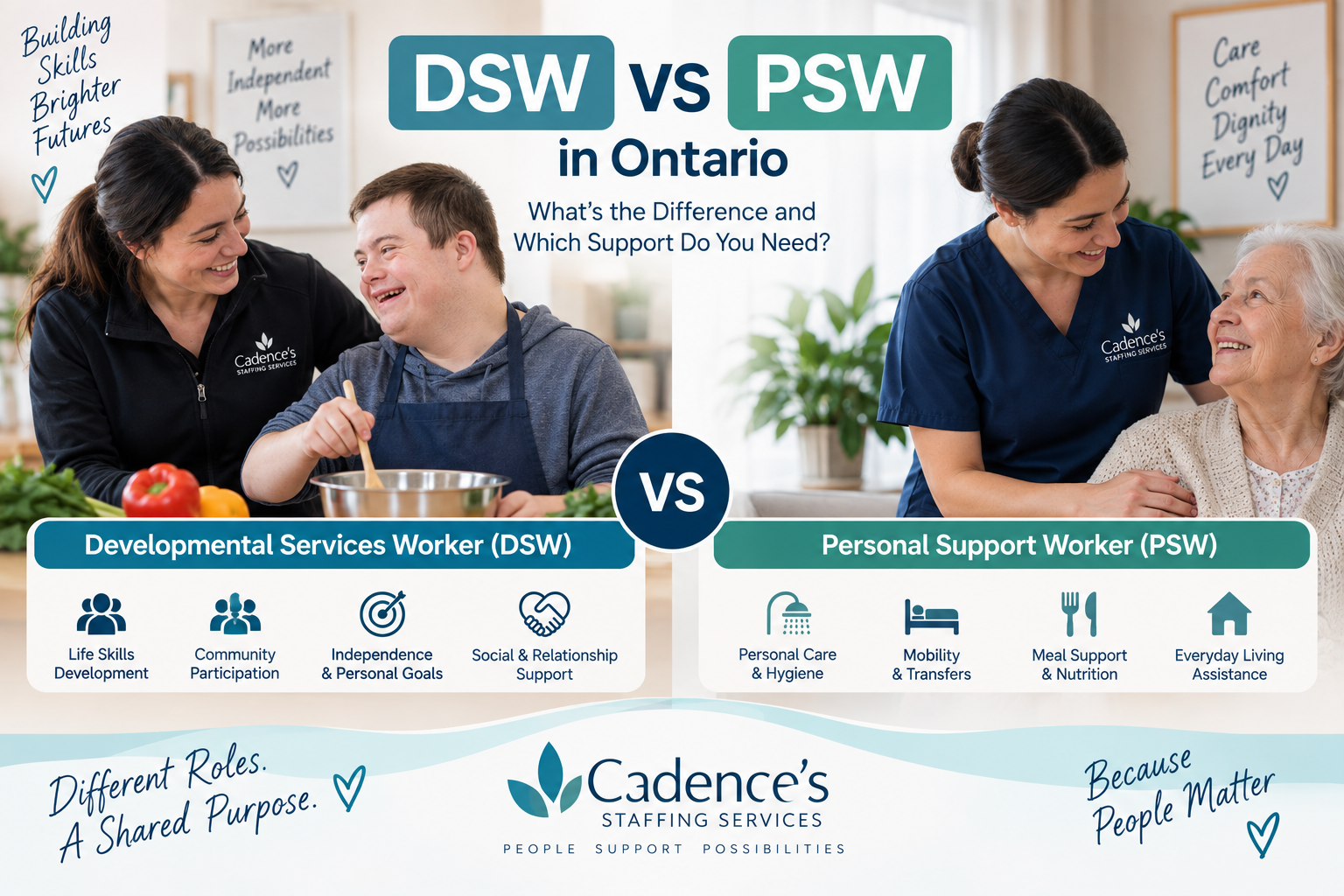
DSW vs PSW — what’s the difference, and how do you know which type of support is right for you or your loved one?
Developmental Services Workers (DSWs) and Personal Support Workers (PSWs) both provide valuable support to people who may need assistance in their everyday lives. However, their training, areas of focus and the type of support they typically provide are different.
For families, caregivers and organizations in Ontario, understanding the difference between a DSW and PSW can make it easier to find support that aligns with an individual’s needs, abilities and goals.
In this guide, we’ll compare DSW vs PSW roles, explore where their responsibilities can overlap and explain some of the factors to consider when choosing support.
DSW vs PSW: What’s the Main Difference?
The simplest way to understand the DSW vs PSW distinction is to look at the primary focus of each role.
A Developmental Services Worker (DSW) is trained specifically to support people with developmental disabilities. Their work can focus on developing adaptive and life skills, promoting independence, supporting relationships, facilitating community participation and helping individuals work toward person-directed goals.
A Personal Support Worker (PSW) typically provides hands-on assistance with activities of daily living and personal care. Depending on the person and setting, this can include support with mobility, hygiene, dressing, eating and other everyday needs.
Both roles are important.
The better choice isn’t about which professional is “more qualified.” It is about which type of training and support best matches the individual’s needs.
What Does a DSW Do?
A Developmental Services Worker supports people with developmental disabilities in increasing their capacity to participate in everyday life and their communities.
A DSW’s work can look different depending on the person they support.
Some individuals may need significant daily assistance, while others may primarily need support developing skills, navigating their community, building relationships or working toward greater independence.
A DSW May Support:
- Daily living and adaptive skills
- Community participation
- Social and communication skills
- Building and maintaining relationships
- Healthy routines
- Person-directed goals
- Independence and self-determination
- Behavioural strategies
- Safety and crisis intervention, where appropriate
- Medication support where appropriate to the role and setting
- Family and community relationships
The emphasis is often on working with the individual rather than simply doing everything for them.
For example, instead of automatically preparing someone’s meal, a DSW might support the individual in choosing a meal, shopping for ingredients and participating in the preparation based on their abilities.
That distinction can be an important part of developmental support.
What Does a PSW Do?
A Personal Support Worker provides assistance to individuals who need help with everyday activities, personal care and maintaining their quality of life.
PSWs work with many different populations and in a variety of care environments.
Depending on the person’s needs and the setting, a PSW may provide assistance with:
- Bathing and personal hygiene
- Dressing and grooming
- Eating and drinking
- Mobility
- Positioning and transfers
- Toileting
- Everyday household activities
- Companionship
- Supporting established care routines
- Observing and reporting changes in a person’s condition
PSWs may work in private homes, community settings, retirement homes, long-term care environments and other care settings.
Their role can be particularly valuable for individuals who require regular hands-on assistance with activities of daily living.
DSW vs PSW: Side-by-Side Comparison
While individual responsibilities depend on the workplace, support plan and needs of the person receiving services, this general comparison can help clarify the difference.
| Area of Support | DSW | PSW |
|---|---|---|
| Developmental disability support | Primary area of specialization | May support individuals with disabilities |
| Personal care | May provide depending on role and setting | Major area of support |
| Daily living skills | Strong focus on developing skills and independence | Often assists with completing daily activities |
| Community participation | Strong focus | May provide depending on care plan |
| Person-directed goals | Core component | May contribute within care plan |
| Social and relationship skills | Common area of support | May provide companionship and social support |
| Mobility and transfers | May assist depending on role/training | Common responsibility |
| Personal hygiene | May assist depending on needs and setting | Common responsibility |
| Behavioural support | May be part of developmental support | Depends on training and setting |
| Independence building | Central focus | Supports independence within personal care needs |
| Developmental services settings | Common | Possible |
| Home and community care | Possible | Common |
These are general distinctions rather than rigid boundaries. The exact responsibilities of either professional can vary according to their training, employer policies, individual competence and the person’s support plan.
DSW vs PSW for Developmental Disabilities
This is where the distinction becomes particularly important.
If an individual has a developmental disability, their needs may extend beyond personal care.
They may benefit from support with communication, social skills, community participation, decision-making, adaptive skills, routines, relationships and long-term independence.
A DSW’s education is specifically oriented toward supporting people with developmental disabilities.
That can make DSW support particularly appropriate when the primary objective is to help an individual develop skills, participate in their community and pursue person-directed goals.
However, having a developmental disability does not automatically mean someone needs a DSW instead of a PSW.
An individual with a developmental disability may also have significant personal care or mobility needs.
In some circumstances, their support needs may involve elements commonly associated with both DSW and PSW services.
The decision should therefore begin with the person—not simply their diagnosis.
When Might You Choose a DSW?
A Developmental Services Worker may be appropriate when an individual’s primary needs involve developmental support, skill building, community participation and independence.
For example, DSW support may be worth considering when someone needs assistance with:
Building Life Skills
A DSW can help an individual develop practical skills such as preparing meals, grocery shopping, managing routines, navigating transportation or participating in household responsibilities.
Increasing Independence
The goal may be to gradually help the person accomplish more independently rather than having someone continuously perform tasks for them.
Participating in the Community
A DSW may support an individual in attending activities, appointments, recreational programs, volunteer opportunities or other community experiences.
Developing Social and Communication Skills
Support may include helping the individual communicate preferences, navigate social situations, develop relationships or strengthen interpersonal skills.
Working Toward Personal Goals
A DSW can help support person-directed goals based on what matters to the individual, their abilities and their desired quality of life.
When Might You Choose a PSW?
A Personal Support Worker may be appropriate when the individual’s primary needs involve hands-on personal assistance and activities of daily living.
For example, PSW support may be worth considering when someone needs regular assistance with:
Personal Hygiene
This can include bathing, grooming, oral care and other personal routines.
Dressing
A PSW may assist someone who has difficulty dressing independently.
Mobility and Transfers
Individuals with physical limitations may require assistance moving safely, repositioning or transferring between surfaces.
Eating and Drinking
Some individuals may need assistance during meals or with other aspects of their daily nutrition routine.
Everyday Personal Support
A PSW may provide assistance that allows an individual to remain comfortable and participate in everyday routines while maintaining as much independence as possible.
Can Someone Need Both a DSW and a PSW?
Yes.
Support needs don’t always fit neatly into one professional category.
Someone may have a developmental disability and also require significant assistance with mobility or personal care.
For example, an adult with a developmental disability may benefit from a DSW for community participation, skill development and person-directed goals while also requiring substantial hands-on personal care.
Depending on the service arrangement and the professionals involved, these needs may be supported by different workers or incorporated into a broader individualized support plan.
What matters is ensuring the person receives the appropriate support from workers who have the training, competence and role expectations necessary to provide it safely.
DSW vs PSW: Which Is Better for Independence?
Both DSWs and PSWs can support independence, but they may approach it from different perspectives.
For a DSW, developing independence is often a central part of developmental services work.
This might involve breaking a task into manageable steps, allowing the individual to practise, adapting the environment or gradually reducing assistance as their skills develop.
A PSW also supports independence by encouraging individuals to participate in their own care and complete activities they are capable of performing.
Neither approach should unnecessarily take control away from the person receiving support.
Good support recognizes abilities, respects choices and provides assistance where it is actually needed.
How to Decide Between a DSW and PSW
Instead of beginning with the question, “Do we need a DSW or PSW?”, begin with a different question:
“What does this person need support with?”
Consider:
- What can the individual currently do independently?
- Which activities are challenging?
- Are their primary needs related to personal care?
- Do they need support developing new skills?
- Would they benefit from more community participation?
- Are communication or social skills an area of focus?
- Are mobility or transfers a significant concern?
- What personal goals would they like to work toward?
- How much hands-on assistance do they require?
- Are there behavioural or complex support needs to consider?
- What type of support would help improve their quality of life?
Once the actual needs are clear, it becomes much easier to determine which type of professional may be appropriate.
Choosing the Right Support Worker Matters Too
Credentials and job titles matter, but they are only part of finding the right support.
The relationship between an individual and their support worker can have a significant impact on the experience.
Families and organizations should also consider qualities such as:
- Reliability
- Patience
- Communication
- Professionalism
- Respect
- Adaptability
- Relevant experience
- Ability to follow individualized support plans
- Comfort working with the individual’s specific needs
- Commitment to dignity and person-centred support
A worker may have the appropriate credentials but still not be the right personality or support match for every individual.
The goal should be finding someone who has both the appropriate skills and the ability to build a respectful, dependable working relationship.
Finding DSW and PSW Support in Ontario
Finding the appropriate support starts with understanding the person.
At Cadence’s Staffing Services, we provide both Developmental Services Workers and Personal Support Workers to support individuals, families and organizations.
Our goal is to understand the needs of the individual or organization before determining the type of support required.
For families, that may mean finding a professional who can support a loved one’s daily routines, independence, community participation or personal care.
For organizations, it may mean accessing qualified DSW or PSW staffing to help maintain reliable support and continuity of care.
Rather than simply filling a position, the focus should always be on finding the appropriate professional for the environment and the people being supported.
Need Help Choosing Between a DSW and PSW?
If you’re still unsure about DSW vs PSW support, you don’t have to make the decision based on a job title alone.
Start by identifying the individual’s daily needs, abilities, challenges and goals.
Cadence’s Staffing Services can help families and organizations explore their support needs and determine which type of staffing may be appropriate.
Contact Cadence’s Staffing Services to discuss DSW and PSW support in Ontario and learn more about the services available.
Frequently Asked Questions About DSW vs PSW
What is the main difference between a DSW and PSW?
A Developmental Services Worker is specifically trained to support people with developmental disabilities, with an emphasis on areas such as adaptive skills, community participation, relationships and person-directed goals. A Personal Support Worker generally focuses more heavily on personal care and activities of daily living.
Is a DSW the same as a PSW?
No. DSWs and PSWs are different roles with different educational focuses, although some of their responsibilities can overlap depending on the individual and work environment.
Can a DSW provide personal care?
Depending on the person’s needs, the setting, employer policies and the worker’s training and responsibilities, a DSW may assist with aspects of personal care. The exact responsibilities should be determined by the individual’s support plan and service provider.
Can a PSW work with someone who has a developmental disability?
Yes. PSWs can support people with disabilities, particularly when assistance with personal care, mobility or other activities of daily living is required.
Is a DSW better than a PSW for someone with autism or another developmental disability?
Not necessarily. The appropriate type of support depends on the individual’s specific needs rather than diagnosis alone. Someone primarily needing developmental skill-building and community support may benefit from a DSW, while someone requiring substantial personal care may benefit from PSW support. Some individuals may require a combination of supports.
Can someone have both DSW and PSW support?
Yes. An individual’s needs can include developmental support as well as personal care. Depending on the service arrangement, different professionals may contribute to an individualized support plan.
How do I know whether my loved one needs a DSW or PSW?
Consider what the individual actually needs help with. Developmental skill-building, community participation and person-directed goals may point toward DSW support, while substantial assistance with hygiene, mobility, dressing and other activities of daily living may point toward PSW support. A support provider can help assess which service is the better fit.
DSW vs PSW in Ontario | What’s the Difference?
DSW vs PSW — what’s the difference, and how do you know which type of support is right for you or your loved one? Developmental Services Workers (DSWs) and Personal Support Workers (PSWs) both provide valuable support to people who may need assistance in their everyday lives. However, their training, areas of focus and the type…

What Does a Developmental Services Worker (DSW) Do in Ontario?
A Developmental Services Worker supports people with developmental disabilities in building independence, developing everyday skills, participating in their communities and working toward personal goals. For families and organizations across Ontario, Developmental Services Workers — commonly known as DSWs — can provide valuable support at home, in residential environments and throughout the community. But what exactly does a…
Healthcare Staffing in Ontario | What’s Changing
The Future of Healthcare Staffing in Ontario | What’s Changing and How Cadence’s Is Responding The Future of Healthcare Staffing in Ontario | What’s Changing and How Cadence’s Is Responding Healthcare staffing in Ontario is changing. Across hospitals, long-term care settings, developmental services, residential programs and community-based care, organizations are navigating a workforce environment that requires…